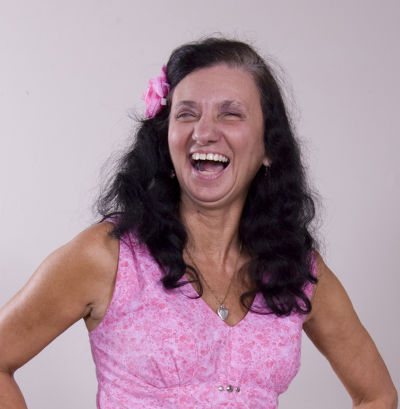
Vision-impaired with glaucoma all her life, Rose became blind as a result of an accident in 1984, a mere four days before she was to undergo a cornea transplant. But not only has that condition not slowed her down, Rose has used it to serve as a means to motivate others to achieve their true potential.
She has used her lack of sight as a springboard to give motivational talks both within and beyond the context of her ministry, Diane Rose Ministries. "The way I look at it, if I can do what I have done, without sight, how much can you do?" she said.
Her achievements are considerable. Even without sight, Rose was heavily involved in the Nashville music scene as a journalist covering the various aspects of, and personalities in, country music.
Diane's music connections have resulted in quilts being sold to such personalities as country music legend Loretta Lynn. "I also made quilts for her to hang in her gift shop," Rose said. Other celebrity clients include Dolly Parton, Porter Wagoner, Ralph Emery and others.
And that's not all. "President Bush has one of my quilts hanging up in the office of his ranch in Crawford, Texas," Rose said proudly. She also presented a baby quilt to Prince William and Kate, before Prince George was born, while she was visiting England.
Diane began quilting on August 14, 1998. She set a goal to make 500 quilts within 10 years. She has exceeded that goal and is now heading toward 1,000 quilts. Diane said, "I make goals and go after them. I believe God chose this talent for me to have and I will use it for His Glory."
So, how does a blind person make a quilt at all, let alone make quilts that famous people would want? "By feel," she said. "The
first quilt I did, I did with polyester instead of cotton." What's the difference? "I could feel the texture of the polyester," she said, "but at that time cotton was too smooth to be able to feel." Over the years, Diane has developed skills that allow her to work with many different materials, patterns, stitches and styles. What is it that she feels for? "I do a lot of appliqué quilts," Rose said, "and you can feel where the stitch is because it's smooth against the main part of the quilt, while the part that's not yet stitched is not smooth."
Diane uses a GO! AccuCut machine to die-cut the appliqués into the different shapes she uses when assembling her quilts. Diane enjoys choosing patterns from quilt books but she also creates her own designs. Some of the quilt patterns she has done are Jacob's Ladder, pinwheels, bear paws, ragged quilts, paper piecing, and blue jeans quilts, as well as many scenery quilts from her own vivid imagination.
Does Rose make custom quilts to order? "Of course I do!" she said. "I make any size quilt requested, I even make Photo Quilts." One such made-to-order quilt she has made for the grandson of the Fosters, 13-year-old Dylan Foster, features big rig-type trucks appliquéd on it. Others Rose displayed featured tractors, cats and other items requested by buyers.